

dNobody posts a photo of a centrepiece. Nobody goes home raving about the tablecloths. What people photograph — what they actually remember and talk about and show people on their phones the next morning — is the moment nobody saw coming. The performer who made the whole room turn. The act that stopped mid-conversation cold. The image that required a caption because words alone didn’t quite cover it.
That’s not an accident. It’s a decision. The Christmas parties that live on in photographs, in group chats, in “remember that night?” conversations two Januaries later — those parties were built around entertainment that was designed, from the start, to be extraordinary to witness. Not just to watch. To be in the room for.
If you’re planning a Christmas event in Toronto and you want it to look as good as it feels — on the night, and in every photo that comes out of it — here’s what actually works, and more importantly, why it works the way it does.
The Mirror Performers: When the Guest Becomes Part of the Image
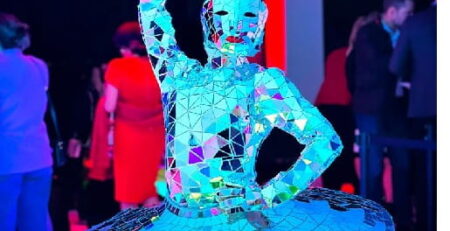
The thing that makes mirror performers so uniquely photogenic isn’t what most people expect. Yes, the costumes are extraordinary — full mirror-tile suits that catch and scatter every light source in the room, turning a single performer into something that looks like a living constellation. But the real reason these acts photograph so well is stranger and more interesting than that: when a guest holds up their phone, they’re not just photographing the performer. They’re photographing themselves. Their face, reflected back from dozens of facets in the costume, fractured and multiplied and lit from every angle. The image they capture is unique to that exact moment, that exact position, that exact expression. No two are the same. No backdrop, no photographer, no instruction required.
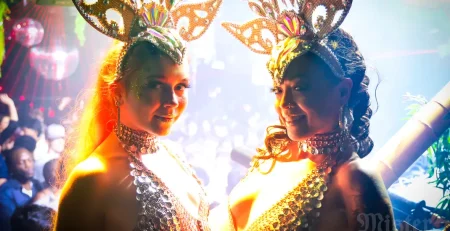
At a Christmas gala, the Living Gold Mirror Duo creates something that decoration alone never could. Gold against December amber lighting — candles, fairy lights, the warm glow that every good event venue has in December — is inherently beautiful. The reflective surfaces take that warmth and multiply it across every frame. And because both performers move through the space, working the room rather than standing at a fixed point, the photography happens continuously across the whole evening. There’s no queue. There’s no designated moment. The content just keeps coming, from every corner of the room, all night.
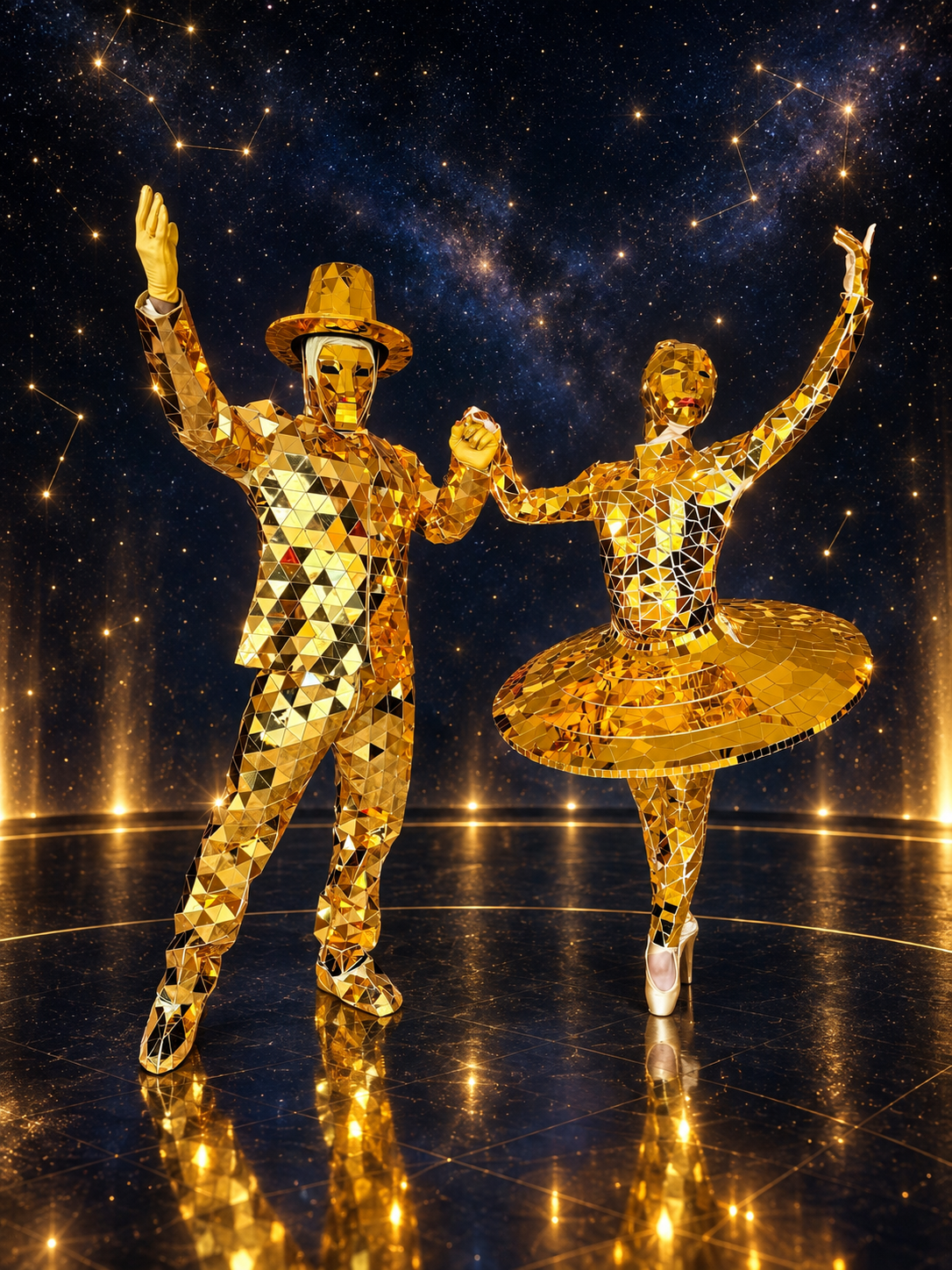
The Human Disco Ball takes the same principle to a different scale entirely. One performer in a full mirror-tile suit that covers every surface from head to foot, moving through a properly lit room, turns the entire venue into a shifting, pulsing light installation. This isn’t metaphor — the light scatter from that costume actually changes what every photograph in the room looks like for as long as the performer is present. Guests photographing each other, the ceiling, the bar, the person next to them: all of it is elevated. The performer doesn’t just appear in the photos. The performer is why the photos look the way they do.
Also read:
Indoor vs Outdoor Christmas Party Entertainment Toronto
What Entertainment Can You Hire for a Christmas Party in Toronto?
The Showgirl Production: Why the Feathers Are Not Incidental
People sometimes assume a showgirl production at a Christmas party is primarily a performance — something to watch, something to be entertained by — and that the photography is a secondary benefit. This gets it exactly backwards. The costumes of a proper showgirl production are, in a very literal sense, optimised for being photographed. Ostrich feathers catch light at angles and in textures that no other material replicates. Sequins scatter it. A headdress that extends two feet above a performer’s head means that even a rushed shot from across the room, taken at an odd angle, through three people’s shoulders, produces a compelling image. The scale does the work that technique can’t.
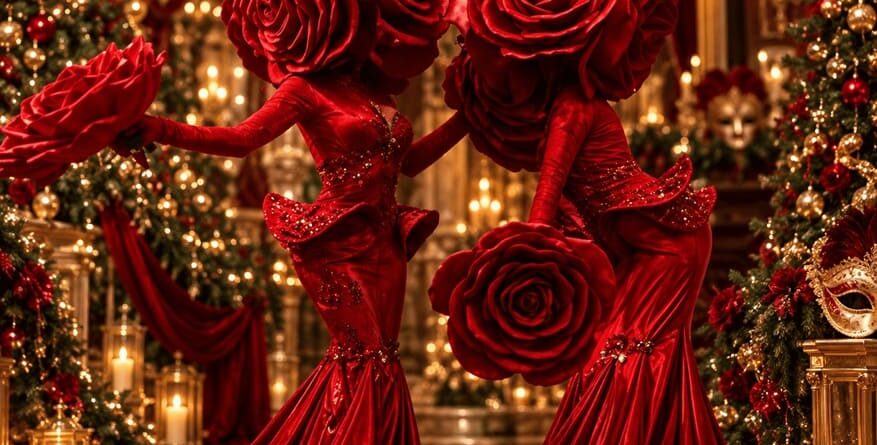
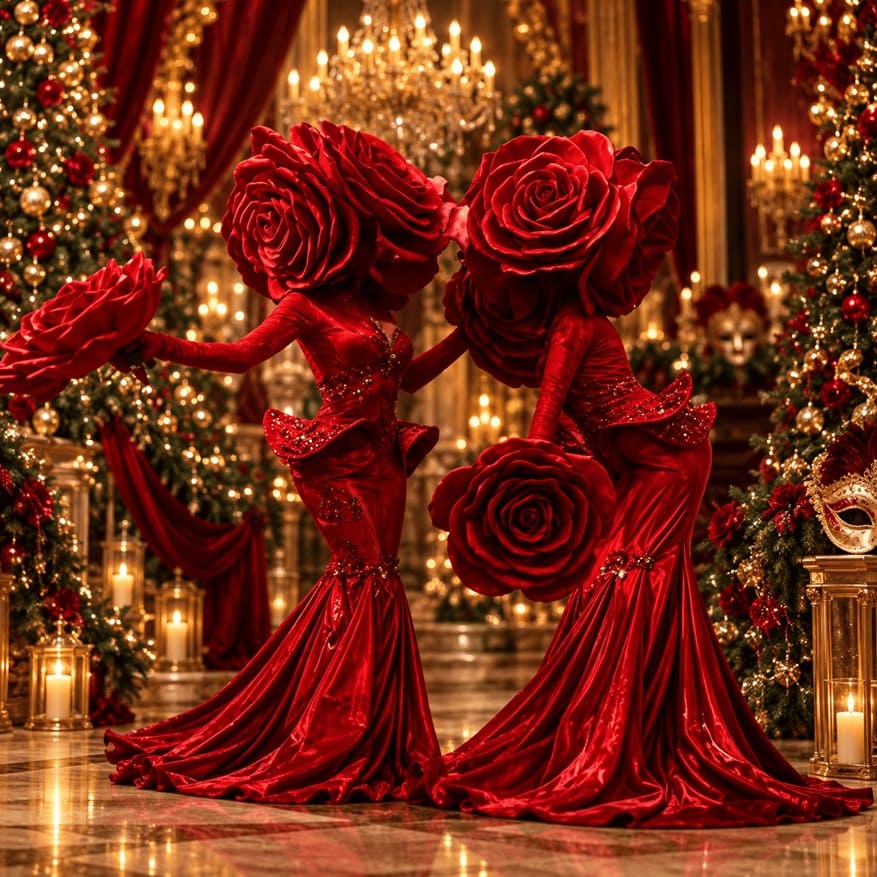 What makes a showgirl production particularly powerful at a Christmas event is colour coherence. When the costuming is in deep red and gold — Christmas red, specifically, not generic red — against a venue that’s already dressed for December, every background element in the frame is contributing rather than competing. The Christmas trees aren’t distracting. The warm venue lighting isn’t fighting the performer. Everything in the room is pointing in the same visual direction, and the result is that even a guest taking a casual phone shot while standing produces an image that looks deliberate.
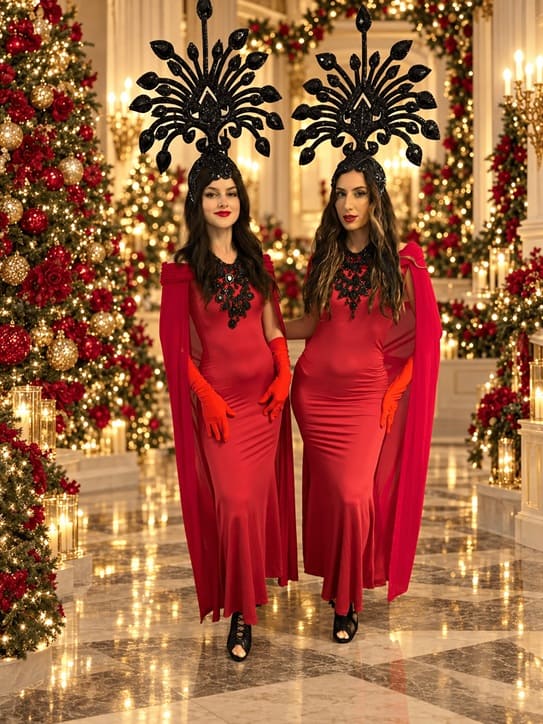
Look at that image and notice what your eye does. It doesn’t settle. It moves — the headpieces to the faces to the gowns to the background — and it keeps finding things. That restlessness is exactly what makes an image shareable. A photo that the eye scans once and understands completely is not a photo anyone sends to someone. A photo that keeps revealing itself is. The dramatic black headpieces against the Christmas warmth of the room, the specificity of that red against those Christmas trees — this is a combination that works because it was designed to, not because December happened to be in the background.
The timing of the showgirl performance within the evening matters for photography in ways that aren’t immediately obvious. Post-dinner, when the floor has cleared and guests are seated, every sightline in the room is open. Nobody is blocking anyone’s shot. The performers have space to work in. That’s not a coincidence — that placement was chosen because it’s when the room is physically configured to produce the best possible photographs of whatever is happening at the front of it.
LED Femme Bot Performers: The Act That Makes Everyone Look Like a Professional Photographer
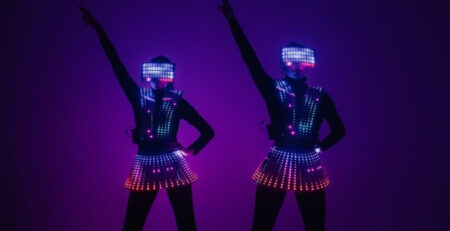
There’s a specific phenomenon that happens at every event where LED Femme Bot performers appear, and it’s worth naming: the photos look professional regardless of who took them. Not “pretty good for a phone shot.” Actually, genuinely professional. The reason is that the suits are, in effect, their own lighting rigs. In a dimmed venue, the programmable LED panels provide precisely the illumination a subject needs to photograph well — the right intensity, the right colour temperature, with the kind of dramatic contrast that makes an image pop on a screen. The suits do what a professional lighting setup would do, but they do it in motion, in the middle of the room, surrounded by people.
The reveal is the most photographed thirty seconds of any event that includes these performers. The room dims. The music shifts. And then the lights come on — not from above, but from the performers themselves. Every phone in the room goes up at the same moment, all pointing at the same thing, all producing a different angle on the same extraordinary image. That cascade of simultaneous capturing is itself a social moment — everyone can see what everyone else is doing, and the shared realisation that something worth photographing is happening right now amplifies the response.
For Christmas events, the LED displays can be programmed in any colour palette. Deep reds and golds for a traditional Christmas aesthetic. Cold whites and silvers for a winter wonderland concept. A company’s brand colours, so the visual moment is simultaneously spectacular and owned. This is the distinction between entertainment that’s impressive and entertainment that’s truly yours — when the performance was built for this event specifically, the images that come out of it belong to this event specifically.
The Champagne Glass: The One That Requires an Explanation
The champagne glass performer creates a reaction so consistent it’s almost scientific: the guest approaches, registers that there is a live person inside a life-size champagne or martini glass, spends approximately five seconds processing this, and then immediately photographs it. What makes this act so persistently effective on social media isn’t just that it looks extraordinary — it’s that the image is inexplicable without context. When someone shares it, they have to say something. They have to explain it. And that compulsion to explain, to narrate, to tag people and say “you have to see this” — that’s the mechanism by which a photo becomes social content rather than just a photo.
As a room centrepiece at a Christmas event, the champagne glass functions simultaneously as entertainment, as décor, and as a continuous content generator from the moment the first guests arrive. It doesn’t perform in a window and then stop. It’s present for the entire arrival period, visible from every angle of the room, and every single guest who walks in photographs it — without being asked, without being directed, without a photographer or a prop coordinator managing anything. The content just happens because the act was designed for exactly this.
Aerialists: The Act That Produces Video
Everything else on this list produces photographs. An aerial performance produces video — specifically, the kind of vertical, continuously moving, compositionally rich video that every content platform rewards. A performer ascending on silk, pausing in a position that defies gravity at six metres above the room, then dropping in a controlled fall that covers the full height of the venue before resolving in a single fluid movement at floor level: this is not something that one image captures. It demands footage. It demands footage from the beginning, because nobody wants to have only the last thirty seconds.
The room dynamic during an aerial performance is worth understanding because it’s genuinely unusual. When a performer ascends, conversations stop. Not awkward silence — the held-breath quiet of a room watching something that doesn’t happen in ordinary life. And then, almost universally, phones come up. Not because anyone announced that the performance was beginning. Because the social cue of two hundred people simultaneously going silent and looking upward is itself the signal that something worth capturing is happening right now. The act generates its own attention, and the attention generates the content.
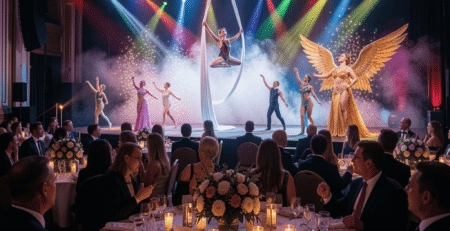
For Toronto Christmas events at venues with the ceiling height for aerial work — Rebel, the Arcadian, the Royal Ontario Museum’s event spaces, hotel ballrooms, a number of the city’s converted industrial venues — aerial is consistently the act that produces the most video content of the evening by volume. Every phone in the room points upward for the full duration of the performance. The footage that comes out of an aerial act at a Christmas event, with the warm glow of a December venue filling the background and the performer suspended above the crowd in seasonal costume, is some of the most genuinely cinematic content any Christmas party will ever produce.
GoGo Dancers: The Visual That Runs All Night
The acts above are event moments — concentrated windows of spectacular visual entertainment. GoGo dancers serve a different photographic purpose entirely: they’re the sustained visual backdrop that makes every photo taken near the dance floor look better than it would otherwise. This sounds like a small thing. It isn’t.
When guests are photographing each other on the dance floor at 10:30pm — not the entertainment, just each other, the casual mid-evening photos that fill the second half of anyone’s camera roll from a good party — GoGo performers in Christmas costuming visible in the background of those shots change what those images look like fundamentally. The entertainment becomes the frame. A photo of two colleagues laughing with a performer in deep red and gold behind them is a genuinely beautiful image. The same photo with a DJ booth and a crowd in the background is a crowd photo. Same people. Different result.
The practical point: GoGo dancer sets timed across the peak hours of the evening — not a single continuous block, but recurring sets at the moments when the floor needs energy and the content needs a visual lift — mean the dance floor looks as good in photographs at midnight as it does at 9:30. That consistency across the whole evening is something that headline-window acts alone can’t provide.
The Roaming Photo Booth: Because Phones Miss Things
Everything above is about creating moments worth photographing. The roaming photo booth is about making sure the best of those moments are actually caught. Not posed — caught. There’s a material difference.
A static photo booth in the corner of a venue captures the photo someone decided to take. A person who walked over, assembled a group, stood in front of the backdrop, smiled. That image is fine. It’s also not the image anyone’s still talking about in February. The images that last are the ones that happened without anyone planning them: the reaction on a guest’s face during the LED reveal, the group that found each other across departments and hasn’t stopped laughing for an hour, the quiet moment between two people who only see each other at this party once a year. These are not images a static booth ever gets. They’re images that only exist if someone with professional equipment is already in the room, moving, paying attention.
At a Christmas party with multiple entertainment acts running across a full evening, a roaming attendant doubles as documentation. The showgirl production, the aerial moment, the champagne glass reveal, the dance floor at its peak — all of it captured at professional quality, available to guests the same night, available to the host for event marketing and social media for months after December. The entertainment was always going to happen. The roaming photo booth is what ensures it’s actually remembered at the resolution it deserves.
Building the Evening as a Visual Sequence
The Christmas parties that photograph best — the ones that produce a camera roll worth scrolling rather than three blurry shots and a group photo — are not built around one spectacular act. They’re built as a sequence, with something extraordinary at each stage of the evening and a different photographic register at each stage. Arrival creates the first impressions: the champagne glass centrepiece doing its quiet, continuous work before anyone has even found their table. Cocktail hour adds movement: mirror performers working the room, producing organic photography from every corner without a designated photo moment. Dinner transitions into the headline performance: the showgirl production or LED reveal, the concentrated moment where the whole room captures the same thing from a hundred different angles. The dance floor runs with GoGo performers providing the visual backdrop that makes the second half of the evening as photographable as the first. And the roaming attendant moves through all of it, filling in everything the phones miss.
None of these acts are competing with each other. Each one occupies a different position in the evening, serves a different photographic purpose, and produces a different kind of image. Together, they build an event that photographs extraordinarily from arrival to last call — not because anyone planned the photography, but because the entertainment itself is the content.
StarMuse Entertainment has been producing Christmas parties in Toronto since 2015. If you’re building an event and you want to talk through which combination of acts works for your venue, your guest count, and your December date, reach out now. The acts that make the visual difference in December are the ones that fill up first — and the earlier the conversation starts, the more options you have to build something genuinely unforgettable.
Frequently Asked Questions
What Christmas party entertainment photographs best in Toronto?
Mirror performers, showgirl productions, LED Femme Bots, champagne glass centrepieces, and aerialists consistently produce the most photographed moments at Toronto Christmas parties. Mirror acts photograph from every angle in any lighting; LED performers make professional-looking images achievable on any phone; showgirls in festive costuming are built from photogenic materials that work beautifully against December décor.
What entertainment creates the best social media content at a Christmas party?
The acts that generate the most organic social content are mirror performers (guests photograph themselves reflected in the costume, producing unique images every time), LED Femme Bots (the light display is visually arresting from every angle in a dimmed venue), and the champagne glass centrepiece (unusual enough that every arriving guest photographs it, and inexplicable enough without context that the image demands a share). Aerialists generate the most video content — the movement is compositionally too rich for a single image to capture.
How do I make my Toronto Christmas party more photogenic?
The most effective single decision is booking live entertainment that is visually spectacular in its own right — acts whose costuming, lighting, and movement create photographic moments naturally throughout the evening, without a photographer corralling guests or a step-and-repeat requiring everyone to stop what they’re doing. Talk to StarMuse about building an entertainment programme for your specific venue and event.
Do I need a professional photographer if I book live entertainment?
A professional photographer is always a good investment for a large Christmas party. But StarMuse’s roaming photo booth service — a professional attendant moving through the event with proper equipment — often produces more genuine, candid images than a traditional photographer, and it documents the entertainment as well as the guests throughout the evening. Images are available the same night.





Comment (1)
[…] The Most Instagrammable Christmas Party Entertainment in Toronto […]