
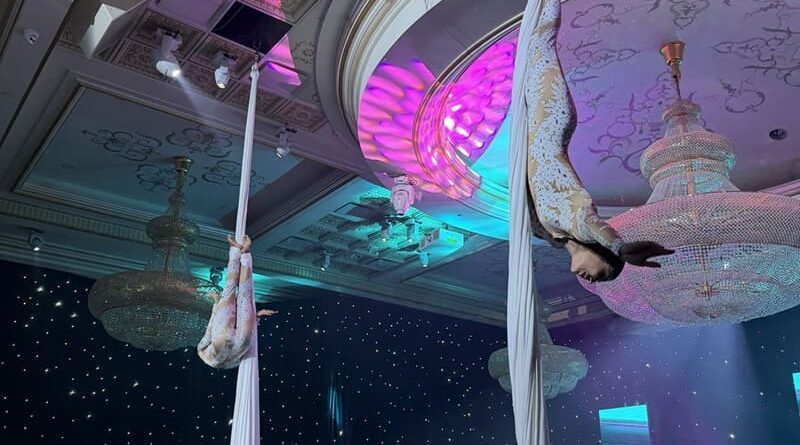
Every year, the same Christmas party gets booked. DJ, open bar, maybe a photo booth in the corner. Everyone has a fine time. Nobody is still talking about it in February. And every year, someone who went to a different party — a party where an aerialist descended above the dinner tables on white silk while two hundred people sat in complete silence — is still talking about that in March.
The gap between those two parties is not money. It’s not the venue, or the guest list, or the year-end budget. It’s one decision: the decision to book entertainment that has never happened at a dinner party in the ordinary run of things, that cannot be replicated by a playlist or a DJ or a step-and-repeat backdrop, and that leaves the room fundamentally changed in the minute it takes to happen.
Aerialists are the most overlooked headline act in Toronto corporate Christmas event entertainment. Not because they’re hard to access. Not because they’re prohibitively expensive. Because most event planners assume they are both of those things and never make the call. This post is for the ones who are still deciding.
Why Aerialists Get Overlooked (And Why Every Assumption Is Wrong)
Ask someone who has never booked aerial performance why they haven’t considered it and you’ll hear the same three things. It’s complicated. It requires a special venue. It’s for massive galas with unlimited budgets. All three are wrong in ways that are worth unpacking directly.
The “complicated” objection usually means: rigging, ceiling height, safety requirements, coordination with the venue. These are real considerations. They are not, however, the event planner’s problem. When you book through a professional entertainment company, every one of those elements is handled in the production process — the ceiling height conversation happens during booking, the rigging is coordinated directly with the venue, the safety requirements are the company’s responsibility, not yours. The complexity is real. The burden is not yours.
The “special venue” objection is the one that rules out the most people prematurely. Yes, aerial requires ceiling height — roughly five to six metres minimum for most silk and hoop work. But Toronto has more venues that meet this requirement than most planners realise. The venues people typically book for upscale Christmas parties — Rebel, Arcadian Court, the Carlu, the Berkeley Church, the Fermenting Cellar at the Distillery — almost all have the ceiling height for aerial work. The industrial conversion spaces that have proliferated across the east end over the last decade frequently do too. The constraint is real. It is not, in Toronto, particularly limiting.
The “massive budget” objection is the most persistent myth and the least accurate. Aerial performance scales with the event. A single aerialist for a fifteen-minute headline set at a mid-size corporate Christmas party is a meaningfully different line item from a full multi-aerialist production. Both are possible. The former is more accessible than most planners assume.
Also read:
What Entertainment Can You Hire for a Christmas Party in Toronto?
Indoor vs Outdoor Christmas Party Entertainment Toronto
The Most Instagrammable Christmas Party Entertainment in Toronto
How to Throw a Cirque Noël Christmas Party in Toronto
What Actually Happens in the Room
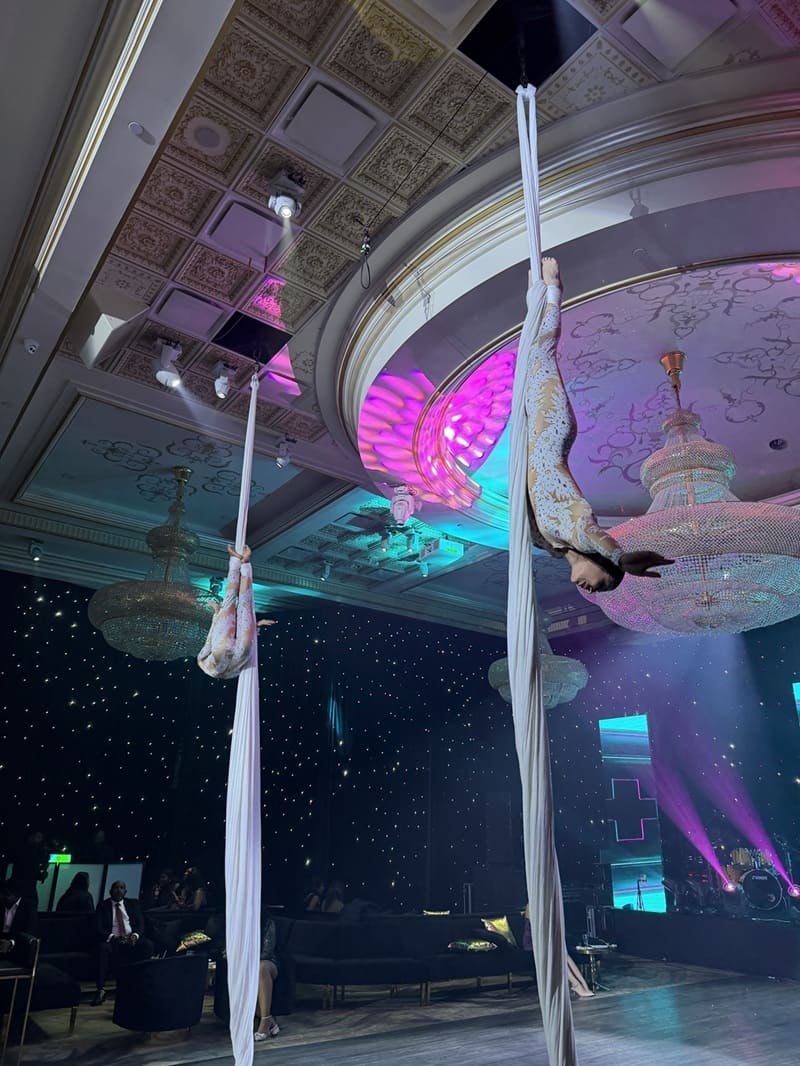
It’s worth describing this precisely, because the experience of watching an aerial performance in a live event space is genuinely different from any reference point most people have for it. This is not Cirque du Soleil seen from row thirty-five. This is a performer ascending thirty feet above your dinner table.
When an aerialist begins, the first thing that happens is silence. Not the polite trailing-off of a crowd being hushed — the specific, involuntary silence of a room that has collectively registered something outside the range of ordinary experience. Conversations stop mid-sentence. Glasses pause halfway to mouths. The person near the door who hasn’t noticed yet looks up because every other face in the room is pointing upward, and that social signal is irresistible.
What follows is fifteen minutes during which nobody in the room is thinking about anything except what is happening directly above them. The performer moves through positions that the human body is not supposed to be able to achieve at that height, in that lighting, in that costume. The silk catches the venue lighting and pulls it into the frame. The movement is continuous and unpredictable and three-dimensional in a way that nothing on a stage floor ever is. And then it ends, and the room exhales, and the applause is the kind that happens automatically — not because the audience has decided to applaud, but because the body starts before the decision does.
That is the moment. That is what people are still describing three months later. Not “we had a great performance.” Something more specific: the precise memory of looking up, the held breath, the particular quality of the silence.
The Practical Reality: Venues, Ceilings, and What to Confirm Early
The single most important thing to know about booking aerial performance for a Christmas party in Toronto is this: confirm the ceiling height before you fall in love with the venue, not after. It is the one variable that cannot be worked around after the fact, and it is the most common reason aerial gets pulled from an event at the last minute — not because anyone made a bad decision, but because someone assumed the ceiling would be fine without measuring it.
Most aerial work on silk or lyra hoop requires a minimum of five to six metres of clear ceiling height from the performance point to the floor. This is not a recommendation. It is a safety minimum. A venue that sits just below this threshold cannot accommodate standard aerial work regardless of how many other requirements it meets. The measurement needs to happen early — ideally at the same time as the initial site visit for the event.
When the ceiling height is confirmed, the next question is rigging. Some venues have permanent rigging points. Others require a temporary structure, which can be brought in but adds to the production scope and needs to be coordinated well in advance. StarMuse’s event management team handles this coordination directly with the venue — the structural assessment, the rigging plan, the load calculations. None of this is left to the client to figure out.
Toronto venues that reliably work for aerial: Rebel on Queens Quay, with its warehouse-scale ceiling and production infrastructure. Arcadian Court, with its extraordinary height and architectural grandeur. The Carlu, one of the most beautiful event spaces in the city and a natural fit for aerial’s visual drama. The Berkeley Church in Moss Park, which pairs industrial ceiling height with a genuinely unusual aesthetic. The Fermenting Cellar at Distillery. A handful of hotel ballrooms — the Fairmont Royal York’s main ballroom, the Westin Harbour Castle — that have both the height and the rigging capacity. If your venue is on this list, the aerial conversation is already half-won.
Where Aerial Belongs in the Evening
Aerial is a headline act. It is not arrival entertainment, it is not background atmosphere, and it is not something to run during the cocktail hour while guests are still finding their bearings. It belongs at the pivot point of the evening — the specific moment that marks the end of the structured, formal part of the night and the beginning of the celebration.
At a Christmas event that runs from 7pm to midnight, that moment is typically around 9 to 9:30pm. Dinner has cleared. The speeches, if there are any, are done. The room is full, settled, and present in the way that an earlier performance slot never quite achieves — the latecomer has arrived, the nervous energy of the beginning of the evening has resolved into comfort, and the crowd has the particular quality of attention that comes from being warm and fed and among people they’re genuinely happy to be with.
That is exactly the room you want when the aerialist ascends. Full. Attentive. Warm. Ready to be astonished.
After the performance, the dance floor opens. GoGo dancers who have been building energy through the second half of dinner step out as the aerial set ends, carrying the momentum directly from the headline moment into the floor. The transition is seamless — from the held-breath silence of the aerial performance into the immediate, physical energy of the dance floor. No gap. No dead air. No moment where the crowd doesn’t know what to do next.
The earlier parts of the evening work beautifully alongside this. Belly dancers and mirror performers during the cocktail hour warm the room and generate the ambient photography that makes the first half of a party feel alive. The champagne glass centrepiece anchors the arrival space with something immediately extraordinary. The champagne skirt host handles the arrival experience with theatrical elegance. All of this builds toward the aerial headline — not as filler, but as a genuine rising arc, with the aerialist as the peak of it.
Aerial vs. Other Headline Acts: Not Better. Different.
It is worth being honest about what aerial is not, because honest comparisons serve better than a sales pitch.
A Las Vegas showgirl production creates a collective experience of glamour and spectacle that is immediately accessible to every person in the room. The scale of the costuming, the choreography, the energy — it hits wide and fast. An aerial act hits differently: more concentrated, more intimate despite the height, more likely to produce a genuinely personal response in each individual viewer. The showgirl production says “this is a spectacular party.” The aerial act says “you are witnessing something that most people never see this close.”
An LED Femme Bot performance is visually extraordinary in a technological, contemporary way — the programmable light suits, the reveal moment, the entire room lit from within by moving performers. It photographs better than almost any other act. It produces an immediate, visceral reaction across the whole room simultaneously. What it doesn’t do is produce silence. The LED reveal produces noise — the right kind of noise, the best kind, the sharp collective intake and then the eruption. Aerial produces silence. Both are powerful. They produce fundamentally different rooms.
Circus acts and contortion performers roam and engage throughout the evening — their power is in the intimacy and surprise of an encounter, not in a headline moment shared by the whole room at once. They are the supporting cast that makes an aerial headline land harder, not a substitute for it.
The question isn’t which is “best.” It’s which is right for this event, this room, this guest list. For events where the brief includes words like “unforgettable,” “theatrical,” or “nothing like last year” — aerial is the answer that every other act points toward.
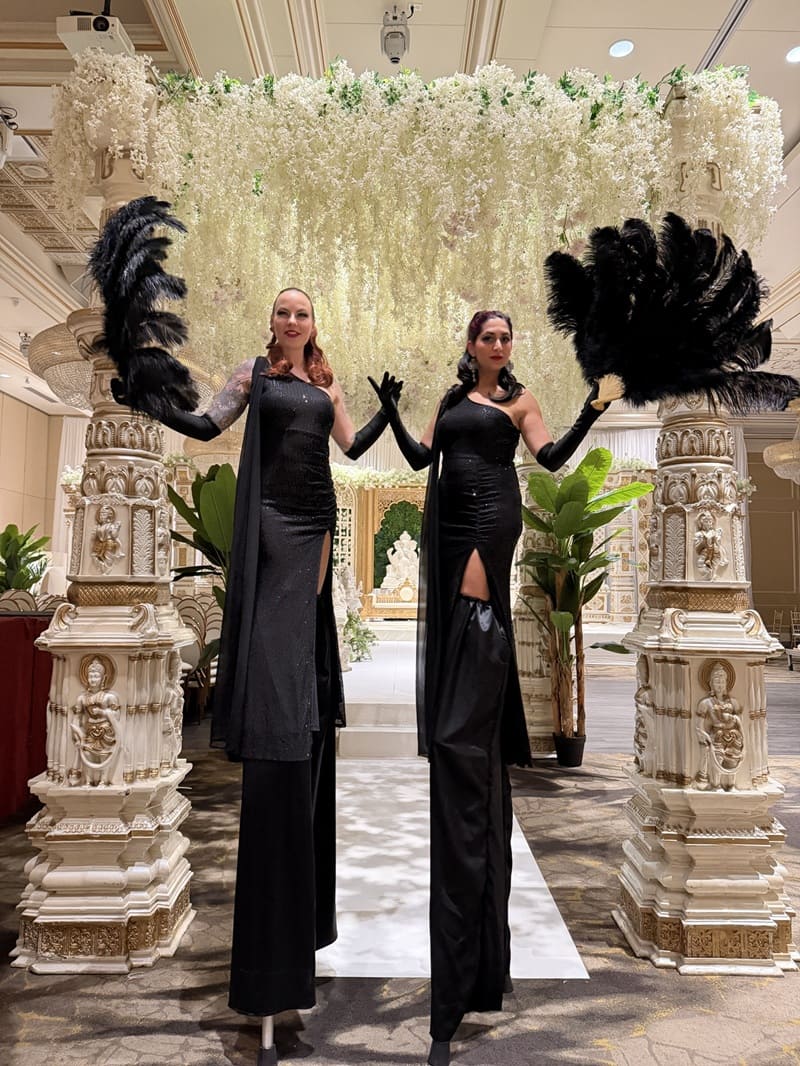
The image above shows something worth noting: the stilt walkers in that frame are not competing with an aerial act. They are building toward one.
The scale of the stilt performance — the height, the drama, the physical presence that fills a room differently from any ground-level performer — primes guests for vertical spectacle in a way that arrives in the aerial headline as a fulfilment rather than a surprise from nowhere.
A programme that includes stilt walkers during arrival, circus performers through cocktails, and an aerial headline after dinner is a programme with a visual logic. Each act raises the register. The aerial act is where it peaks.
Who This Is Actually For
Aerial performance at a Christmas party is not exclusively for 500-person corporate galas at Rebel. That association is the single biggest misconception that keeps mid-size events from booking it.
An intimate private dinner for 80 people in a venue with the ceiling height for aerial is a better aerial event, in some ways, than a 400-person gala. The closeness of the performance to the audience — the fact that every person in the room is within fifty feet of a performer thirty feet in the air — creates an intensity that larger rooms dilute. The silence lands harder when it’s eighty people rather than four hundred. The collective experience is more concentrated.
The events that typically book aerial through StarMuse span a wide range: corporate year-end galas for financial and technology firms, private holiday parties hosted in upscale event spaces, agency and creative industry celebrations where the brief explicitly asks for something nobody has seen before, and mid-size professional services events where the client list is small but the impression matters enormously. Across all of these, the response is consistent. The aerial act is the moment the evening is remembered by.
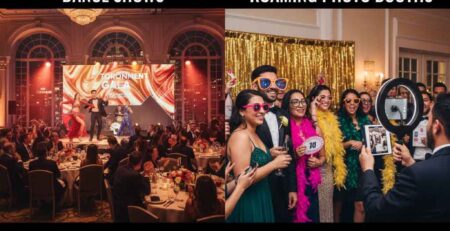
The roaming photo booth captures it properly. Phone footage of an aerial act, shot in the available light of a live event, is usually the best-looking video content on anyone’s camera roll from that evening — the movement, the height, the light on the silk, the expressions of the people watching. A professional roaming attendant makes sure the best angles are caught at the quality they deserve, and the images are available the same night.
The Booking Window: When to Move and What You Lose by Waiting
December is the most compressed month in Toronto’s events calendar. Every corporate Christmas party, every year-end gala, every private festive gathering is competing for the same four or five December weekend dates. The performers who make those events extraordinary are not available indefinitely.
For aerial specifically, the December booking window closes faster than for most other acts. Aerialists are booked for extended residencies, multi-event December runs, and long-lead corporate contracts that often start being confirmed in September. The best performers — those with the experience, the physical condition, and the production credits that a high-stakes event requires — are not available on three weeks’ notice in December. They were confirmed in October.
If your Christmas event is in December and you are reading this in November, you are at the edge of the useful planning window. If you are reading this in October, you are exactly where you need to be. The venue conversation and the entertainment conversation should happen simultaneously, not sequentially — because the venue suitability for aerial needs to be confirmed before the entertainment is contracted, and both need to be locked before December fills up around you.
StarMuse Entertainment has been producing Christmas parties with aerial performance in Toronto since 2015. If you want to talk through whether your venue works, what an aerial programme looks like for your specific event, and what dates are still available, reach out now. The conversation takes fifteen minutes. The evening it produces lasts considerably longer than that.
Frequently Asked Questions
Can you hire an aerialist for a Christmas party in Toronto?
Yes. StarMuse Entertainment books professional aerialists for Christmas parties across Toronto and the GTA, performing on aerial silk, lyra hoop, and trapeze. The key practical requirement is ceiling height — a minimum of five to six metres — and confirmed rigging points at the venue. StarMuse’s production team coordinates both directly with your venue as part of the booking process, so you’re not navigating it alone.
What venues in Toronto can host an aerial performance at a Christmas party?
Toronto venues well-suited to aerial performance include Rebel, Arcadian Court, the Carlu, the Berkeley Church, the Fermenting Cellar at the Distillery District, and several hotel ballrooms including the Fairmont Royal York and the Westin Harbour Castle. The critical requirement is ceiling height of at least five to six metres and confirmed rigging capacity. StarMuse confirms venue suitability as part of the booking conversation — it’s one of the first things we establish.
Where in a Christmas party programme does an aerial act belong?
As the headline performance after dinner — typically around 9 to 9:30pm at a Christmas event that starts at 7. This is the pivot point of the evening: the room is full, dinner is cleared, and the natural transition from the formal to the celebratory part of the night is exactly when aerial lands hardest. After the aerial set, GoGo dancers open the dance floor and carry the energy forward. The evening never drops.
Is aerial performance only for large-scale corporate Christmas galas?
No — and this is the misconception that most often stops mid-size events from booking it. Aerial works from around 80 guests upward, and in a more intimate venue the closeness of the performance to the audience is part of the effect. StarMuse books aerial for private dinners, mid-size corporate events, and large galas. The venue ceiling height matters far more than the guest count.






Leave a Reply