
Somewhere in Toronto right now, someone is planning an office Christmas party and trying very hard to make it not feel like an office Christmas party. They’ve looked at the venue options, worried about the budget, wondered whether anyone actually wants to come, and quietly accepted that it will probably be fine — meaning inoffensive, moderately enjoyed, and forgotten by the second week of January.
This is the wrong ambition. And the reason most office Christmas parties land in that “fine” category has almost nothing to do with the venue or the food. It has to do with what happens — or doesn’t happen — in the room. Specifically, it has to do with whether anyone gave the guests a reason to be genuinely glad they came.
Live entertainment does that. Not background music. Not a photo booth in the corner. Not a DJ who plays the same playlist every company used last December. Entertainment — acts that create moments the whole room experiences together, that give colleagues something to talk about besides work, that make the evening feel like it was designed to be memorable rather than obligatory. The difference between a party people attend and a party people want to attend almost always comes down to this.
Here’s what actually works for a corporate crowd, and why.
The Problem With Most Office Christmas Parties
The typical office Christmas party has a structure that works against fun almost by design. Everyone arrives in professional mode — because they spent the day in professional mode, with the same people, in the same building. They stand around with drinks, talking about the safest possible topics because the person next to them is also their colleague. Dinner happens. Speeches happen. The dance floor opens and everyone waits for someone else to go first. By 10pm, the people who have to be at their desks tomorrow have quietly left, and the people who stayed are mostly the ones who would have had fun at any party.
The entertainment decisions most companies make don’t address this. A DJ doesn’t solve the first-hour awkwardness. A photo booth in the corner doesn’t create a shared moment. A playlist doesn’t give a room full of people a reason to look at each other and say, out loud, “that was extraordinary.” Something has to happen to break the professional mode that everyone walked in wearing. Something has to give the room permission to actually celebrate.
Live performers do this in a way that nothing passive can replicate. When something genuinely spectacular appears in a room — when a performer in a costume nobody expected materialises at a cocktail table, or the lights dim and something extraordinary begins to unfold — the professional mode evaporates. Everyone in the room is experiencing the same thing at the same time, and that shared experience is what breaks the ice that an open bar spends two hours trying to melt.
Start Before Dinner: The Cocktail Hour Is Not Throwaway Time
The first mistake corporate event planners make is treating the cocktail hour as setup time — the gap between arrival and dinner that fills itself with conversation and nibbles. It doesn’t fill itself. It fills with the particular social awkwardness of a room full of colleagues who aren’t quite sure what register to operate in yet, standing in clusters of people they already know, waiting for the formal part of the evening to begin.
Roaming entertainment dismantles this faster than anything else. A belly dancer moving through the arrival space — not performing on a stage, but working the room at the same level as the guests — creates warmth and energy before a single formal element of the evening has started. Guests who arrived separately, who are still finding their bearings, who haven’t had a drink yet: they respond to live movement instinctively. The entertainment gives them something to look at, something to respond to, something to talk about with the person standing next to them who isn’t from their department.
The mirror performers — the Living Gold Mirror Duo, the Shimmer Ballerina, the Human Disco Ball — work particularly well for a corporate cocktail hour because they roam and they photograph brilliantly. Every colleague interaction near a mirror performer produces a genuinely extraordinary photo. The entertainment becomes the conversation starter. By the time dinner is called, the room has warmed in a way that two hours of an open bar alone never achieves in the same timeframe.
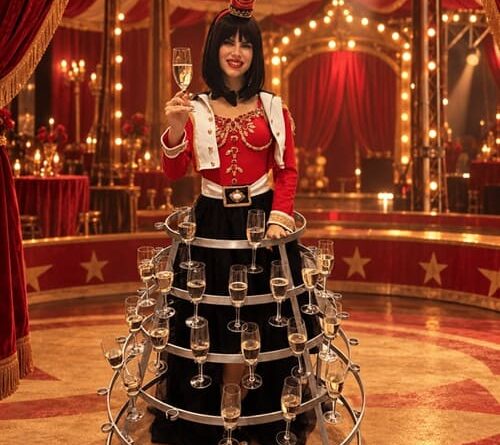
The champagne glass centrepiece — a live performer inside a life-size champagne or martini glass — creates a continuous focal point for the entire cocktail hour. Every guest who hasn’t encountered one before does a double-take. Every double-take produces a photograph. Every photograph produces a conversation with the nearest colleague. The act does the social work of a room-warming exercise without anyone having to organise an icebreaker.
 The Headline Act: The Moment That Makes the Evening
Post-dinner is when the office Christmas party either becomes genuinely memorable or confirms every reservation the reluctant attendees had about coming. The dance floor is open. The speeches are done. And now the question is whether the energy sustains or quietly deflates. This is the window that a headline entertainment act owns — and owns completely, when it’s the right act.
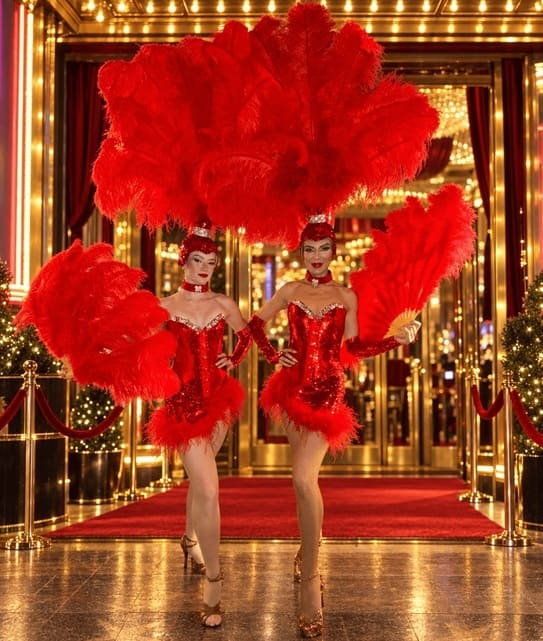
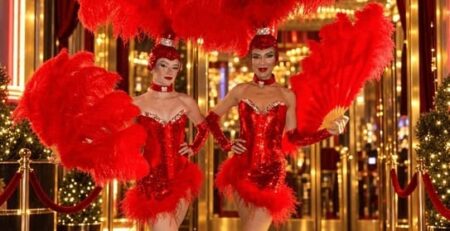
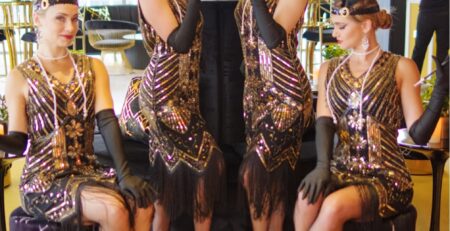
A Las Vegas showgirl production — full choreography, feathered headdresses, sequined costuming in Christmas palettes, performed in the room with the guests rather than on a distant stage — does something specific that matters enormously for a corporate crowd: it gives everyone in the room an equal, shared experience. The CEO and the junior hire are watching the same thing, at the same time, with the same expression on their faces. The hierarchy that structures every other hour of the working day disappears for fifteen minutes. Everyone is just a person watching something extraordinary.
That’s not a small thing. It’s precisely what an office Christmas party is supposed to do — create a moment outside the ordinary register of work where people can be colleagues rather than job titles — and most parties never achieve it. A DJ doesn’t do it. Dinner doesn’t do it. A showgirl production, a room full of people who didn’t expect it, in a venue dressed for December: that does it.
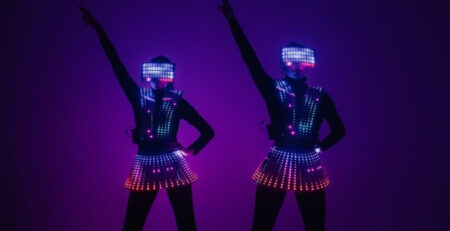
The LED Femme Bot reveal is the alternative for companies that want something more contemporary and visually futuristic — tech companies, creative agencies, and organisations where “theatrical” skews younger. The programmable LED suits can carry a company’s brand colours or festive palettes, the reveal moment is total and immediate, and the images it produces — which every guest in the room will capture and share — look extraordinary regardless of the photographer. For a corporate event that doubles as a social media moment for the company, this is the act that works hardest.
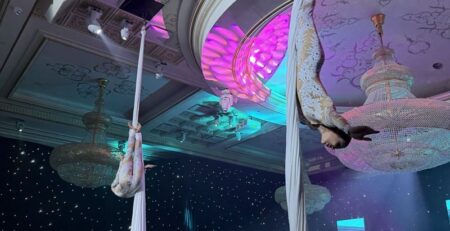
If the venue has the ceiling height, an aerial performance on silk or lyra hoop is the headline act that produces the most genuinely held-breath moment of any of these options. The room goes quiet in a way it doesn’t for any other entertainment. And that silence — shared across a room full of colleagues who spend their working days in various states of distraction — is itself a kind of gift. Something made everyone stop at the same time. That’s memorable in a way that “it was a fun night” never is.
The Dance Floor: Don’t Leave It to the DJ Alone
Opening a dance floor at a corporate Christmas party is an act of optimism. Someone has to go first. That person has to be willing to be watched by their colleagues. And the transition from “seated dinner crowd” to “actually dancing crowd” can take anywhere from five minutes to never, depending entirely on what the room’s energy is doing in that moment.
GoGo dancers solve the transition problem. When trained performers open the floor — not standing on podiums above it, but working in the space itself, drawing the crowd in through the specific gravitational pull that professional dancers have — the floor fills faster and stays fuller. The activation energy required from individual guests drops to almost nothing. They’re not going first. They’re joining something that’s already happening.
For a corporate crowd specifically, GoGo dancers provide something additionally valuable: they signal that the professional context of the evening has fully ended. The performers are on the floor. The music is for dancing. This is no longer a work event with drinks; it’s a party that happened to start at work. That permission — explicit, visual, unambiguous — is what most corporate Christmas parties spend their whole evening trying to create through atmosphere alone and rarely achieve.
Timed sets across the peak hours — not one continuous block from 9pm to midnight, but recurring sets at the moments when the floor’s energy naturally wants to dip — mean the dance floor is alive and active through the whole late-evening period rather than peaking early and gradually thinning. The difference between a party that’s fully energised at 11pm and one where everyone’s checked out by 10:30 is very often this: whether the entertainment was treated as a first-half proposition or as a thread running through the whole evening.
The Acts That Work Across Every Corporate Crowd
Different companies have different cultures, different ages of workforce, different industries, and very different collective comfort levels with entertainment that’s genuinely surprising. The acts that work universally — across the finance firm and the ad agency, across the team that goes hard at every event and the team that always leaves by 10 — are the ones that don’t require audience participation, don’t single out individual colleagues, and don’t depend on the crowd’s pre-existing energy level to succeed.
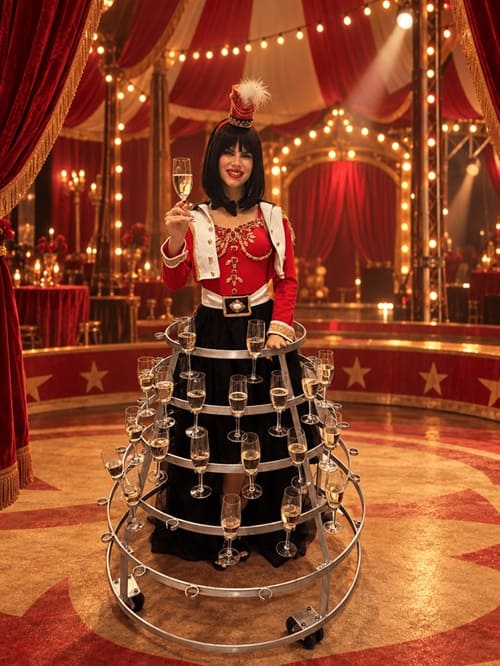
The champagne skirt host is one of these universal acts. A performer in a dramatic structured skirt that carries the drinks service itself, moving through the crowd at arrival, is both entertaining and functional. It’s inclusive — every guest is part of it, because every guest gets champagne — and it requires nothing from the audience. The more reserved guest and the most enthusiastic guest have the same experience. Nobody is put on the spot. The act works regardless of what the room is doing.
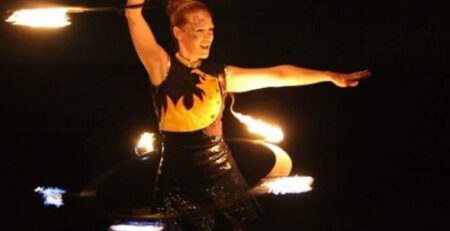
Circus performers roaming during cocktail hour share this quality. They appear, they perform at close range, they create a reaction, they move on. The guest who wants to engage can engage. The guest who wants to watch from a slight distance can do that. The act adapts to the audience rather than demanding the audience adapt to it. For a corporate crowd where individual comfort levels with entertainment vary enormously, that adaptability is the difference between an act that lands across the whole room and one that works for some guests and alienates others.
Also read:
What Entertainment Can You Hire for a Christmas Party in Toronto?
Indoor vs Outdoor Christmas Party Entertainment Toronto
The Most Instagrammable Christmas Party Entertainment in Toronto
How to Throw a Cirque Noël Christmas Party in Toronto
Why an Aerialist is the Best Christmas Party Entertainment You Haven’t Considered
The Roaming Photo Booth: Documentation That Does Double Duty
Every corporate Christmas party should have documentation — images that capture the evening, that the company can use for internal communications and social media, that employees can actually keep. What most parties get instead is a static booth in the corner that produces posed group shots with props: entirely fine, entirely forgettable, entirely inadequate as a record of an evening that cost real money and real planning to produce.
A roaming photo booth attendant captures the evening that actually happened. The reaction shot when the showgirl production begins. The group that found each other across departments and hasn’t stopped laughing for an hour. The candid moment during the aerial act when every face in the room is pointed upward with the same expression. These are the images that last — not because they’re technically superior, but because they’re genuine. They’re what the evening looked like from inside it, not what it looked like when everyone stopped to pose.
For a corporate client, this documentation has value well beyond the night itself. The images from a well-photographed Christmas party — especially one with visually spectacular entertainment — are usable for employer branding, internal communications, and social media content for months. The return on a roaming photo booth is not just the guests’ camera rolls. It’s the company’s archive of a night worth remembering.
The Structure That Actually Works
The office Christmas parties that people genuinely look forward to — the ones that come up in conversation the following December as the benchmark — share a common structure. Not the same acts, not the same venue, not the same budget. The same intention: entertainment treated as a thread through the whole evening rather than a box to tick in one window.
Arrival entertainment warms the room before the first formal moment. Roaming acts through cocktail hour break the professional ice. A headline performance after dinner creates the shared moment the evening is building toward. GoGo dancers open the floor and sustain the energy through peak hours. And a roaming attendant documents all of it at the quality it deserves.
None of this requires an enormous budget or a venue with a hundred requirements. It requires deciding, early enough to actually book the acts you want, that the entertainment is the investment — not an afterthought to the venue and the catering. The evening is only as good as what happens in it. The venue is just the room.
StarMuse Entertainment has been producing corporate Christmas parties in Toronto since 2015 — companies of twenty people and companies of two hundred, in function rooms and in landmark venues, across every industry in the city. If you’re planning an office Christmas party and you want it to be the one people actually remember, reach out now. December books faster than any other month. The earlier the conversation starts, the better the evening gets.
Frequently Asked Questions
What entertainment works best for an office Christmas party in Toronto?
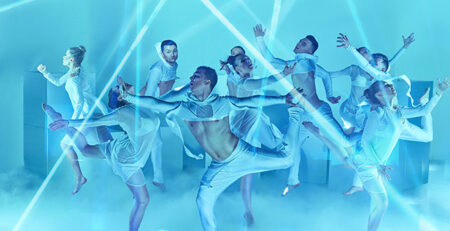
The most effective combination for a corporate crowd is roaming entertainment during cocktail hour — belly dancers, mirror performers, or a champagne glass centrepiece — followed by a headline performance after dinner (a dance show, LED Femme Bots, or aerialists if your venue has ceiling height), with GoGo dancers opening and sustaining the dance floor through peak hours. The right specific combination depends on your team size, venue, and company culture.
How do you make a corporate Christmas party more fun?
The single most effective change is adding live entertainment that creates shared moments — acts the whole room experiences together, without anyone having to organise anything. A showgirl production after dinner, an LED performer reveal, or an aerial act gives every guest a genuine reason to be in the room and removes the awkward professional-mode energy that makes most office parties feel like work with drinks. It gives colleagues something to respond to together, which is exactly what a Christmas party is supposed to do.
What is a good budget for office Christmas party entertainment in Toronto?
Budgets vary by act type, number of performers, duration, and event date. December weekend dates carry peak-season rates. Contact StarMuse at 647-998-7167 or info@starmuse.ca for a quote specific to your team size and brief.
When should I book entertainment for an office Christmas party in Toronto?
October is the right window. The most popular acts for corporate Christmas parties — showgirl productions, aerialists, LED performers — are confirmed well before December arrives. If you’re in November, move quickly. December weekend dates are the most competed-for dates on Toronto’s events calendar, and the acts worth booking fill up first.




Leave a Reply