
Before hiring event entertainment in Toronto, ask about the company’s local experience, the range of acts they offer, how performances can be customised to your event, what happens if a performer is unavailable, what the venue and staging requirements are, how they coordinate with your event timeline, and what insurance and references they can provide. These seven questions reveal whether a company is a genuinely reliable, professional partner — or simply a listing on a booking website with no real accountability behind it.
Hiring entertainment is one of the highest-impact decisions in event planning, and also one of the easiest to get wrong. A performer who arrives late, an act that does not suit your venue, or a company that cannot answer a simple logistics question can derail an evening that took months to plan. The good news is that the right questions, asked early, filter out the wrong fit before you have signed anything. Here are the seven that matter most.
1. What Experience Do You Have with Events in Toronto Specifically?
Local experience is not a nice-to-have — it is one of the strongest indicators of reliability. A company that has worked across Toronto and the GTA for years understands the city’s venues, knows how load-in works at specific hotels and event spaces, and has built relationships with venue staff that smooth out logistics on the day.
Ask how long the company has operated in Toronto, and ask for examples of venues they have worked at before. A company that can immediately name venues — ballrooms, nightclubs, festival sites, corporate event spaces — and describe how a performance was adapted for each one is demonstrating real, lived experience rather than a generic pitch.
What a strong answer sounds like: a company with a documented history at recognisable Toronto venues, ideally spanning multiple event types — corporate, private, and nightlife — over several years. StarMuse Entertainment, for example, has operated in Toronto since 2005, with ongoing residencies at venues including Rebel and Cabana Pool Bar, and performances at major festivals across the city.
2. What Types of Acts and Performers Do You Actually Offer?
This question matters more than it sounds. Many entertainment “companies” are actually booking agencies that subcontract performers from a wide network with limited quality control. A company with its own roster of trained performers, costumes, and choreography has direct accountability for the quality of what shows up at your event.
Ask for a clear breakdown of the specific acts available, not just broad categories. A company that can walk you through distinct, well-defined offerings — and explain the difference between them — is one that understands its own product.
For reference, here is the kind of range a well-established Toronto entertainment company should be able to offer:
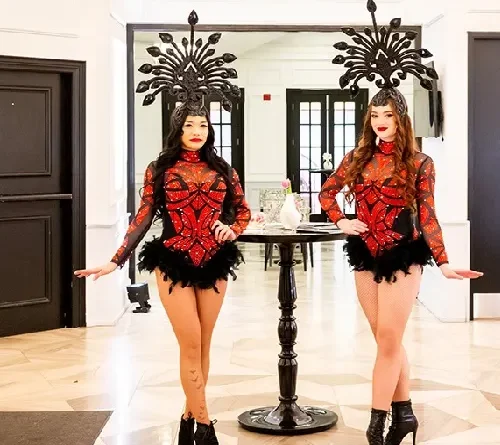
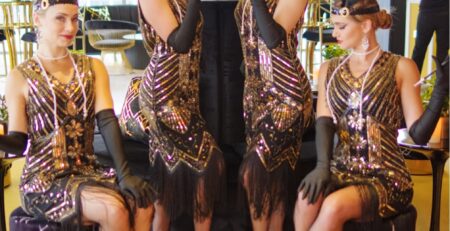
- Dance shows — themed, choreographed productions such as Las Vegas showgirl, Great Gatsby, disco, and 80s/90s retro performances, plus custom-choreographed pieces
- GoGo dancers — high-energy crowd entertainers performing on platforms with freestyle and choreographed routines
- Belly dancers — roaming or stage performances suited to cocktail hours and culturally themed events
- LED dancers and lasers — including LED Femme Bot performers with brand logo display capability, LED wing dancers, and laser performers
- Aerialists — silk, hoop, ribbon, aerial umbrella, and trapeze performers for headline visual moments
- Circus acts — including contortion and other specialty variety performances
- Mirror performers — living mirror acts for greeting guests and roaming entertainment
- Champagne skirt performers — a hosting and serving act that doubles as a visual centrepiece
- The champagne glass performer — a signature visual act featuring a performer inside a life-size champagne glass prop
- Body painting performers — live art performances suited to creative and brand-led events
- Roaming photo booths — mobile photo entertainment that moves through the event
If a company can speak fluently about each of these formats — what makes them different, and which events they suit — that is a strong sign of genuine expertise rather than a generic catalogue.
3. Can the Performance Be Customised to My Event’s Theme or Brand?
Generic entertainment is forgettable. The acts that guests remember are the ones that feel like they were designed specifically for that event — matching a colour scheme, reflecting a brand identity, or tying into a couple’s story or a company’s milestone.
Ask directly: can costumes be adjusted to match our event colours? Can choreography incorporate a specific theme or concept? For corporate events, can branding — logos, messaging, colour palettes — be integrated into the performance itself?
This is where the difference between a catalogue booking and a genuine entertainment partner becomes clear. A company offering custom-choreographed dance shows built around your specific brief, or LED Femme Bot performers capable of displaying your company logo on the costume itself, is offering something a generic booking platform cannot.
4. What Happens If a Performer Is Sick or Unavailable?
This is the question many people forget to ask — and the one that matters most when something goes wrong. Performers get sick, flights get delayed, and emergencies happen. The difference between a professional company and an unreliable one is what happens next.
Ask specifically: do you have backup performers trained on the same routines? How quickly can a substitute be arranged? Has this happened before, and how was it handled? A company with a roster of performers who train together and can step into each other’s roles is far less likely to leave you without entertainment on the day. A company that cannot answer this question clearly is a risk.
5. What Are the Venue and Staging Requirements?
Different acts have very different physical requirements, and mismatches here cause more day-of problems than almost anything else. A company that asks detailed questions about your venue before confirming a booking is doing its job properly.
Some examples worth understanding in advance:
- GoGo dancers typically need a raised platform or podium, not necessarily a full stage
- Aerialists require sufficient ceiling height and secure rigging points — this needs to be confirmed with your venue well in advance
- LED performances and laser dancers have the most visual impact in dimmed spaces — if your venue is brightly lit, this should be discussed before booking
- Dance shows involving larger productions need adequate stage depth and wing space for costume changes and formations
- Roaming acts like belly dancers and mirror performers are flexible and work in almost any layout, including outdoor spaces
A good entertainment company will ask for your venue name, room dimensions, ceiling height where relevant, and floor plan — and will flag any concerns before the contract is signed, not on the day of the event.
6. How Do You Coordinate with Our Event Timeline and Other Vendors?
Entertainment does not exist in isolation. It needs to be timed around dinner service, speeches, a DJ’s set, or a product reveal — and it needs to fit alongside your photographer, AV team, and venue coordinator without creating conflicts.
Ask how the company handles pre-event coordination. Do they have a single point of contact who communicates directly with your planner or venue? Do they confirm arrival times, load-in windows, and performance slots in writing before the event? Will they do a walkthrough or sound check if needed?
This matters across every type of act — whether it is a single champagne glass performer positioned at a specific moment during cocktail hour, or a full circus act requiring set-up time before guests arrive. Companies that manage this coordination proactively — rather than expecting you to chase them for details — are the ones that make an event run smoothly.
7. Do You Have Insurance, References, and a Track Record I Can Verify?
This is the trust-and-safety question, and it is non-negotiable for any venue with liability requirements — which, in Toronto, is most hotels, banquet halls, and corporate venues.
Ask for proof of public liability insurance. Ask for references from past clients, ideally for events similar in scale and type to yours. Ask if they can share photos or video from previous bookings — genuine, dated content from real events, not just polished promotional material.
A company with a long operating history in Toronto, a visible body of past work, and a willingness to provide references without hesitation is one you can move forward with confidently. Hesitation or vague answers to this question is one of the clearest warning signs in the entire process.
Putting It All Together
None of these seven questions are difficult for a genuinely professional entertainment company to answer. That is, in fact, the point — the ease and clarity of the answers is itself the signal. A company with real experience in Toronto, a defined roster of acts, the ability to customise performances, a plan for contingencies, a clear understanding of staging requirements, proactive timeline coordination, and verifiable insurance and references is a company you can trust with one of the most visible parts of your event.
StarMuse Entertainment has been answering these exact questions for clients across Toronto and the GTA since 2005. From themed dance shows and gogo dancers to aerialists, LED Femme Bot performers, and signature acts like the champagne glass performer, the team can walk you through exactly how each act works, what it needs from your venue, and how it fits into your event timeline. The event management team can also help coordinate multiple acts as part of a single, seamless entertainment plan.
If you are planning an event in Toronto and want to talk through what would work, get in touch with StarMuse — or learn more about the team behind the company on the About Us page.





Leave a Reply